School Rules and Regulations
Find out what's expected of students at school, from attendance and dress code to the use of mobile phones and technology.
School Rules and Regulations
(I) National Anthem and Pledge
Students must attend and stand at attention during the Flag Raising and Pledge-taking ceremony.
Students who are Singapore citizens must sing the National Anthem and take the Pledge. Students will take the Pledge with the right fist placed over the heart.
(II) Attendance and Punctuality
Students are to attend school on a daily basis. They are only allowed to miss school when they are ill and their absence must be covered with a medical certificate and produced immediately upon return to school.
All students must be in school on normal school days by 7.30 a.m. daily for Pledge-taking and the singing of the National Anthem.
Each student must have a book to read during pre-assembly. Students are required to bring a Mother Tongue storybook on Tuesdays and Wednesdays and an English storybook on Thursdays and Fridays.
All students are to be punctual for all lessons and school activities. They are not allowed to leave the classroom and school premises during school hours without the teacher’s permission.
(III) Absence from school
Students who are absent from school are to produce a medical certificate or a letter of excuse from their parents/guardians.
Parents/Guardians are requested to inform the child/ward’s Form teachers if their child/ward is unable to come to school.
Students who are not feeling well during school hours and who wish to be dismissed early must obtain prior permission from their teachers. Their parent/guardian will be contacted to fetch them from school. Students are not allowed to go home on their own.
Students on long medical leave (e.g. due to chickenpox, HFMD, etc) are to be certified fit by doctors before returning to school.
Students are strongly discouraged from leaving Singapore during term time unless under special and urgent circumstances. We do not want students to miss out on lessons and other school learning experiences. Should your child be required to travel during term time, kindly write in to the respective Year Heads to request for permission to do so.
(IV) School Attire and Appearance
Students are to wear the prescribed school uniform and modification to the uniform is not allowed.
The school badge and name tag are to be worn at all times on the school blouse/shirt and PE t-shirt.
The name tag must be sewn below the school badge.
Spectacles worn by students must be functional and should not be a fashion accessory.
Footwear
White socks, above 7cm from opening of shoe to be worn.
Fancy socks / socks with brand logos / ankle socks are not permitted.
Only fully white PVC / canvas shoes are allowed.
Coloured trimmings / glitter on shoes are not permitted.
Sports shoes are allowed for Sports CCAs on CCA days.
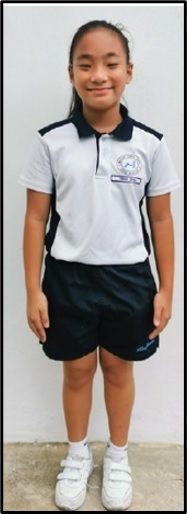
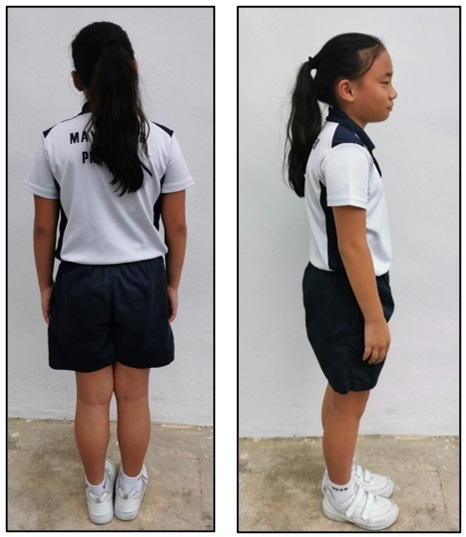
Boys’ and Girls’ PE Attire
The polo t-shirt should be tucked neatly at all times.
Students are allowed to wear PE attire on days that they have PE lessons, CCA days and other days when they are required to stay back for elective/CCA extra practices.
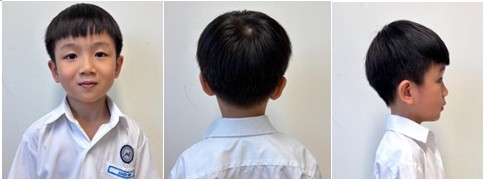
Boys
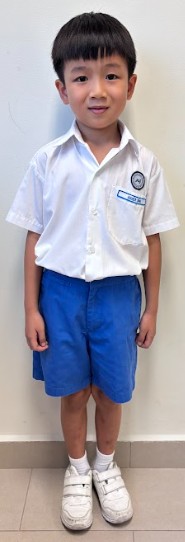
Hair must be kept short and neat.
Hair must not cover the forehead, touch the eyebrows, ears or collar.
No outlandish (spiky, punk, layered, shaved, tails, undercut) hairstyles
No ear piercings.
Tinting, bleaching and colouring of hair are not allowed.
Shirt to be tucked in at all times.
Must be neat in appearance, clean-shaven and no facial hair is allowed.
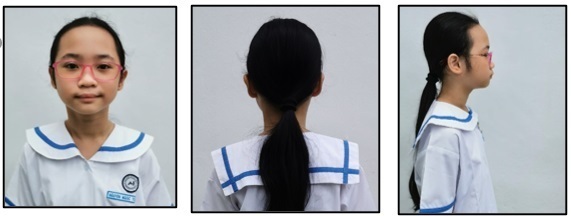
Girls

Fringe must not be touching the eyebrows.
Hair beyond shoulder length must be plaited or tied up.
Only black/dark blue hair accessories are allowed.
Tinting, bleaching and colouring of hair are not allowed.
One pair of plain gold /silver studs may be worn on one ear hole of each ear. Other forms of piercing / fancy /loop earrings are not allowed.
Skirt length must cover the knees.
No jewellery or any item of personal adornment is allowed.
(V) Littering / Vandalism
Students must treat school property and environment with care and respect.
Students must not litter the school premises.
Students must not willfully or maliciously destroy school or personal property or write graffiti.
(VI) Anti-Bullying Policy
TOWARDS A CARING AND ENABLING SCHOOL ENVIRONMENT
School is a safe space where children aged 7 to 12 learn, interact, and develop prosocial behaviour. Their experiences with peers and adults shape their understanding of relationships, values, and appropriate conduct.
In their interactions, when hurtful actions occur, these can lead to bullying. There is zero-tolerance towards bullying and the school takes all instances of hurtful actions seriously.
When school is kept safe for everyone working and learning in it, we build a warm culture where all stakeholders feel cared for.
Our Commitment
To create a safe environment, anchored on our values of integrity and respect, and in line with our mission to touch the hearts of our children, so that they may all be gracious, empathetic learners of MFPS.
What is Bullying? (The 4 Pillars of Bullying)
A behavior must meet all four of these criteria at the same time to be called bullying:
Intentional: The hurtful behavior is done on purpose.
Repeated: The action happens multiple times to the same person.
Hurtful: The behavior causes physical or emotional pain.
Power Imbalance: The person targeting others has more power or influence.
Important Rules for Parents & Students
The 4-Criteria Rule: If a behavior only meets 1, 2, or 3 of these points, it is not bullying.
Occasional Actions: Single or random hurtful acts are treated as separate misconduct or conflict.
Escalation Warning: Occasional hurtful actions that start happening regularly will then become bullying.
Bully can take different forms, such as:
Physical: hitting, kicking etc
Cyber: misuse of online platforms etc
Verbal: name-calling, making threats, spreading rumours etc
Social: leaving someone out / encouraging others to ignore someone
Preventive Approaches To Target Anti-Bullying
We adopt a proactive and whole-school approach to prevent and address bullying through education, student leadership and a strong culture of care:
1. Prevention through Education
CCE lessons on anti-bullying, being an upstander, and cyber wellness
Regular class-based discussions (FT interaction time, circle time) to build empathy and respectful relationships
2. Student Voice and Peer Support
Class Captains (P1-P6)
Care Ambassadors in every P4–P6 class to promote inclusivity and look out for peers
Cyber Wellness Student Ambassadors to advocate for responsible online behaviour
3. Whole School Communication and Culture Building
School-wide messaging through Principal’s weekly sharing at assembly and student leadership platforms (e.g. Head Prefect’s weekly speech)
Ongoing staff alignment and awareness through regular staff communications
4. Clear Reporting and Early Intervention
Multiple accessible reporting channels for students and parents
Encouraging early reporting so that concerns can be addressed promptly before escalation
This approach ensures that bullying prevention is not limited to reactive measures but embedded in everyday school experiences and relationships.
Reporting Channels
Students and parents can inform the school about hurtful behaviour/bullying actions in several ways:
For Students:
Direct reporting to any staff member (FTs/ Subject Teachers/CCA Teachers or staff in General Office)
Care Ambassadors (in every P4 - P6 class)
Support Box helmed by the Prefectorial Board (for anonymous reporting)
Class Captain P1-P6
Student Leaders (Prefects, Junior Prefects, CCA Captains)
For Parents:
Incident reporting using school general email address found in school website
Contact teachers using teachers’ email address found in school website
Incident reporting using the online form found in school website
Our Response
Immediate physical and psychological safety measures for all students involved
Prompt investigation and timely updates, subject to case complexity
Safety plans for affected students
Consequences focussing on learning prosocial skills and relationship repair
Restorative support including school counselling, external referrals and community resources where appropriate
Partnership with parents throughout the process, including informing parents at the earliest opportunity
How Parents Can Support
Have conversations with your child about school experiences and friendships
Teach respectful behaviour and reinforce healthy digital habits at home
Monitor your child’s online and offline interactions and activities
Share concerns promptly with your child’s Form Teacher or Year Head
Work collaboratively with school on agreed interventions
Model positive behaviour in your own interactions, such as being calm and respectful in communications
Use 'teachable moments' in your daily interactions with your child to explain why certain conduct is inappropriate
We are here to listen and help.
We review this policy regularly to make sure it continues to serve our school community well. Your feedback and suggestions are always welcome.
Together, we shape our students’ character, strengthen relationships, and build caring communities.
(VII) Mobile Phones, Smart Watches and Electronic Devices
We recognise that mobile phones and smart watches are part of everyday life for many students and that they provide a useful means of communication between them and their family members. However, they can prove to be a great distraction to their learning. We would therefore like to remind parents and students of the school policy on the use of such devices which is in alignment with MOE’s guidelines.
Students are not to use personal digital devices^, during school hours including recess, CCA and after-school programmes (e.g. supplementary/enrichment/remedial lessons)
Students are not allowed to bring these digital devices which may disrupt or distract them from their learning in school.
Should parents/guardian wish for your child/ward to bring these digital devices to school, parents/guardian need to complete an online form the “Permission to Bring Mobile Phone / Smart Watch to School”. Parents are to contact their child’s Form Teacher if they wish to apply for the sticker.
Students who bring such devices are to put them in their school bags before school start time. They can retrieve the devices after school ends. Students should bear responsibility for safekeeping of devices.
The school will not be responsible for any loss or damage of the digital devices the student brings to school.
These digital devices are to be switched off at all times during school hours. Students are allowed to use their personal digital devices only outside the school building after dismissal.
If students are caught using their digital devices in the school premises, these digital devices will be confiscated, and parents/guardian will be required to collect them personally from the teacher.
Mobile phones and smart watches will not be allowed into examination venues during national exams as well as school-based exams.
Successful applicants will be given a sticker. Students with the sticker are to paste it at the back of their mobile phone / smart watch. This approval is only valid for the year of application. Parents / Guardians are strongly advised to go through the guidelines with their child / ward before letting them bring the mobile phone / smart watch to school.
Should students need to contact their parent / guardian when they are in school, they can seek assistance from the general office staff. On learning journeys outside the school, students can approach the teachers-in-charge for help if they need to contact their parents.
^ Digital devices refer to any electronic items (including smart phones, smart watches and electronic books) that are capable of capturing, storing, displaying and / or transmitting visual, audio or verbal information.
(VIII) Prohibited Items
All students are not allowed to have in their possession any weapon. They are also not allowed to bring any weapon-like item which can be used, is used or intended to cause harm to oneself or others.
(IX) Responsible Use of Technology
You should interact with others in a respectful and responsible way. You should not post online remarks that are
• racially and/or religiously insensitive, vulgar and/or offensive, or hurtful to others.
You should not use any devices to
• store, modify, create or share content (e.g. documents, presentations, pictures and videos) that is inappropriate (e.g. indecent, pornographic, defamatory, hurtful to self or others).
• make threats, cause harassment or embarrassment, impersonate or intimidate others.
You should not use MOE/school-deployed ICT system accounts for any commercial activities (e.g. buying and selling of goods and services).
Non-compliance with the above will lead to disciplinary action in accordance with the school’s discipline policy